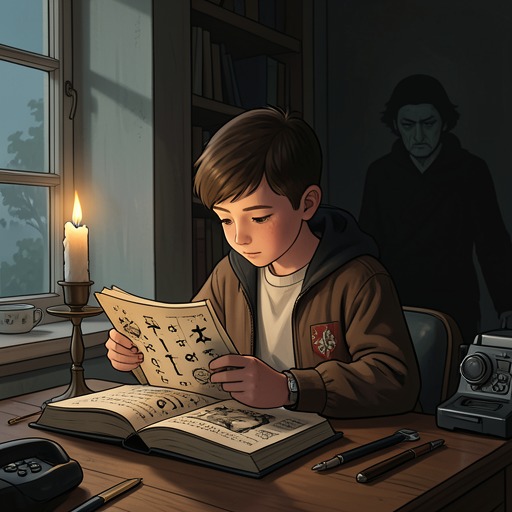
C. S. Lewis and Miss C.
Surprised by JoyC. S. Lewis and Miss C. were bound by affection and care, but their relationship also became a turning point in Lewis’s religious and imaginative life. As matron at Chartres, Miss C. offered a lonely, orphaned boy exceptional kindness; her interest in occult traditions, meanwhile, exposed him to a vision of supernatural reality that unsettled his prior beliefs. Lewis’s retrospective account holds these effects together: she was both a source of genuine good and the inadvertent occasion for a lasting inner conflict.
Miss C. as Matron
Lewis introduces Miss C. with marked tenderness, reluctant to assign blame and comparing the care required in doing so to pointing out an error in his own mother. He remembers her as an outstanding matron, skilled at comforting sick boys and cheerful company when they were well. He describes her as selfless and says that the boys loved her; because he was an orphan, he felt that love especially strongly.
Miss C. was still seeking a settled spiritual understanding. Lewis recalls her exploring Theosophy, Rosicrucianism, Spiritualism, and the wider Anglo-American occult tradition. He presents this search not as malice or a plan to weaken his faith, but as a sincere attempt to find truth and a way of life. She did not realize that her conversations would matter so greatly to a boy whose religious ideas had not prepared him for the possibility of supernatural beings beyond God and humanity.
Affection and Religious Upbringing
Lewis credits Miss C. with helping to counter an emotional restraint formed by his early experiences. By awakening his affections, she challenged what he later calls an anti-sentimental inhibition. Her influence therefore cannot be reduced to the damage he associates with his growing interest in occultism: even while identifying serious religious consequences, he acknowledges the warmth and spiritual benefit of her presence.
The contrast is clearest in his memory of the faith he had brought from his earlier life. He had enjoyed imaginative accounts of strange sights and other worlds without believing them literally. His invented worlds of Animal-Land and India were, in his view, not evidence that he confused fantasy with fact; he knew himself to be their creator. Miss C.’s discussions changed the question for him. For the first time, he considered that marvels might exist in reality and that the visible world might conceal regions outside the limits of his simple theology.
Occult Fascination and Apostasy
Lewis describes the resulting attraction to the preternatural as an appetite that could make other interests seem unimportant while it held sway. He believed this fascination could help explain the appeal of magic, but his account is principally about its effect on his own attention and convictions. Occult speculation did not remain confined to ideas about hidden realms: its vagueness spread, in his recollection, to the doctrines of his Christian faith, making them seem matters for personal feeling rather than truths demanding belief and obedience.
He captures that change through the remembered movement from saying that he believed to saying that one merely felt. The shift brought relief from the demanding certainty he associated with his earlier religious experience. In his later metaphor, the intense light of revelation gave way to the cooler atmosphere of what he calls Higher Thought, where he could accept what comforted or excited him without feeling bound to obey. He does not claim that Miss C. intended this result. He instead portrays her innocent remarks as the occasion on which a deeper force acted within him.
Separation and Retrospective Judgment
Miss C. eventually left Chartres at the same time as a much-loved under master, around the midpoint of Lewis’s stay, which lasted from the spring term of 1911 to the end of the summer term of 1913. Lewis cannot give a precise chronology for his gradual abandonment of Christianity, but he marks their departure as a boundary after which the school declined in what he calls solid good, despite no corresponding decline in apparent happiness.
Distance did not erase his mixed judgment. Looking back, Lewis maintains that Miss C. had been an occasion of both good and harm: her affection helped loosen his emotional inhibition, and he found elements of genuine, disinterested spirituality in her teaching, even though he considered its main effect on his faith disastrous. The relationship thus carries a deliberate tension. Lewis preserves his gratitude and love for the matron while locating the responsibility for his religious change more carefully than simple blame would allow.